German vocabulary size of learners vs. native speakers
· Grigory Golovin · Updated November 9, 2026 · 🌐 German · dataviz
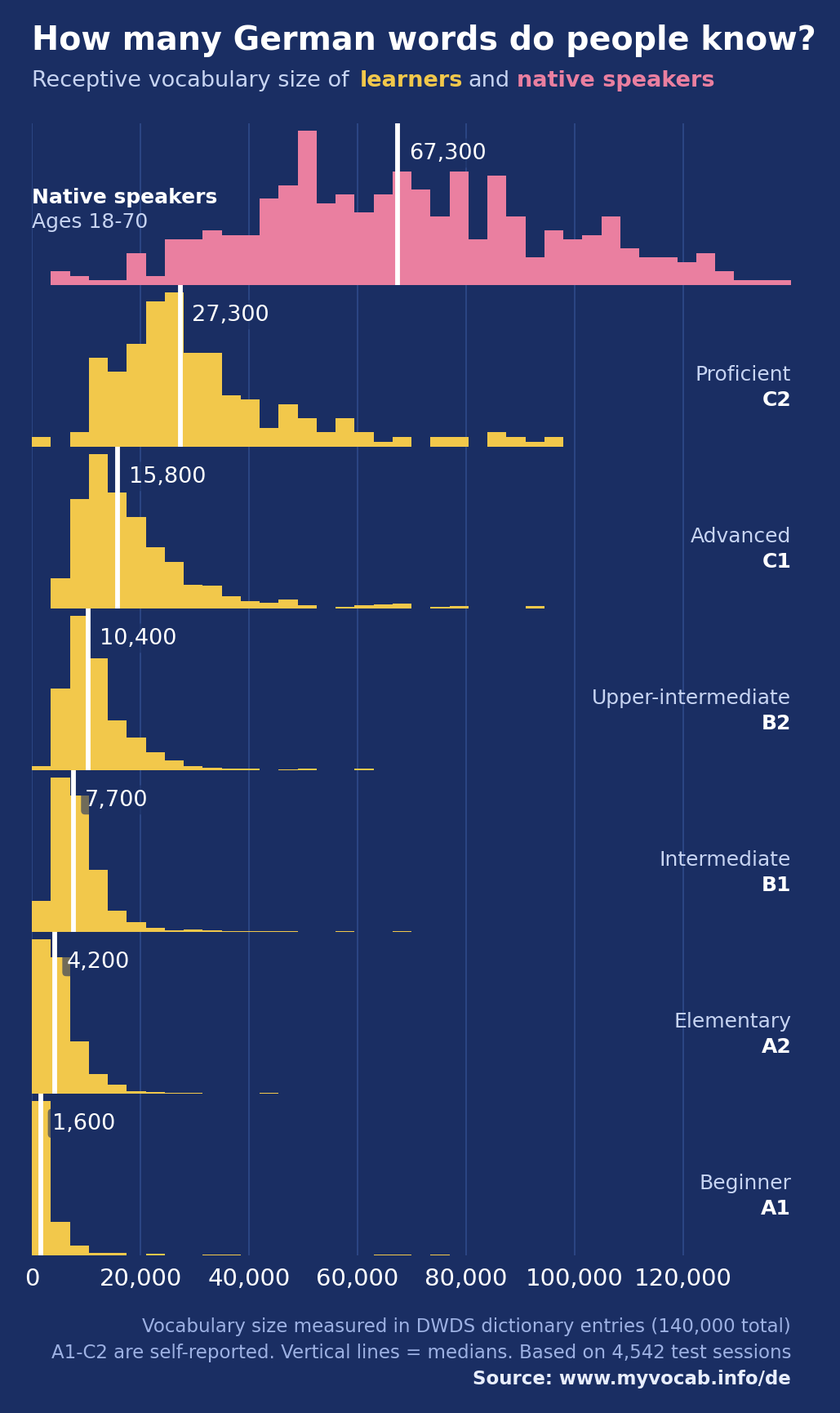
The data are based on the results of the BRAVE vocabulary test.
Who the respondents are
Top countries where respondents came from:
- Native speakers aged 18-70 (447 sessions): Germany 90%, Austria 3%, Switzerland 2%, Brazil 1%, Spain 1%.
- Non-native speakers (4,095 sessions): Germany 43%, Russia 8%, United States 5%, Austria 5%, Switzerland 4%, Ukraine 4%, United Kingdom 3%, The Netherlands 3%, Poland 3%, Belarus 1%.
Notes
- The data were collected between August 2021 and November 2026.
- Data were cleaned to remove sessions with low response quality: more than 1 fake item checked, more than 3 multiple-choice follow-up questions answered incorrectly, response time too fast (<40 s) or too slow (>300 s). Only the first attempt per user was retained.
- BRAVE measures receptive vocabulary — words we understand but do not necessarily use.
- Results are in entries of the Digitales Wörterbuch der deutschen Sprache (DWDS), out of 140,000 entries in total (only non-empty articles).
- The CEFR levels were self-reported.
- More details on how the test works are in the methodology (in German).