Vocabulary Size of English Speakers
We present the results of a large-scale online study of English speakers’ vocabulary. The study is based on the BRAVE English vocabulary test, designed for both native and non-native speakers. We aimed to answer the following questions:
- How many words do people actually know?
- How does the vocabulary size of native speakers grow with age?
- How large is the difference between the vocabulary sizes of native and non-native speakers?
- How many word families do non-native speakers know at each proficiency level?
Participants
First, let's look at who took the test. To date, over 308,000 respondents have completed BRAVE, including 29,000 native and 279,000 non-native English speakers. Participants came from all around the world:
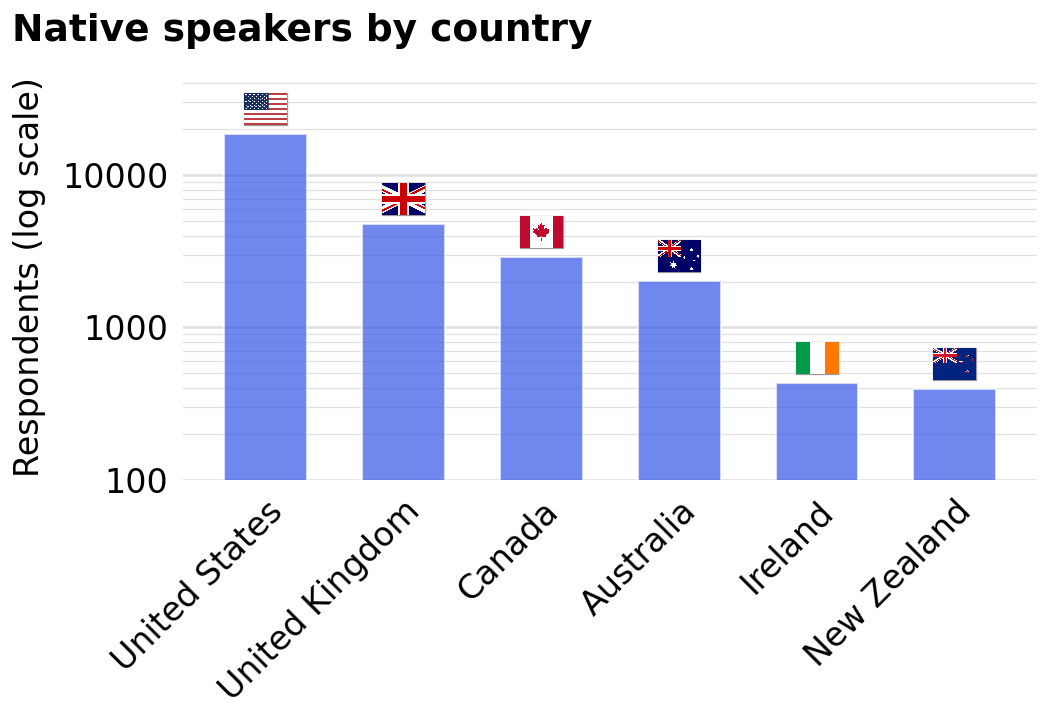
Most of the native speakers (64%) came from the United States, 16% from the United Kingdom, 10% from Canada, and 7% from Australia. Ireland and New Zealand each contributed less than 1% of participants.
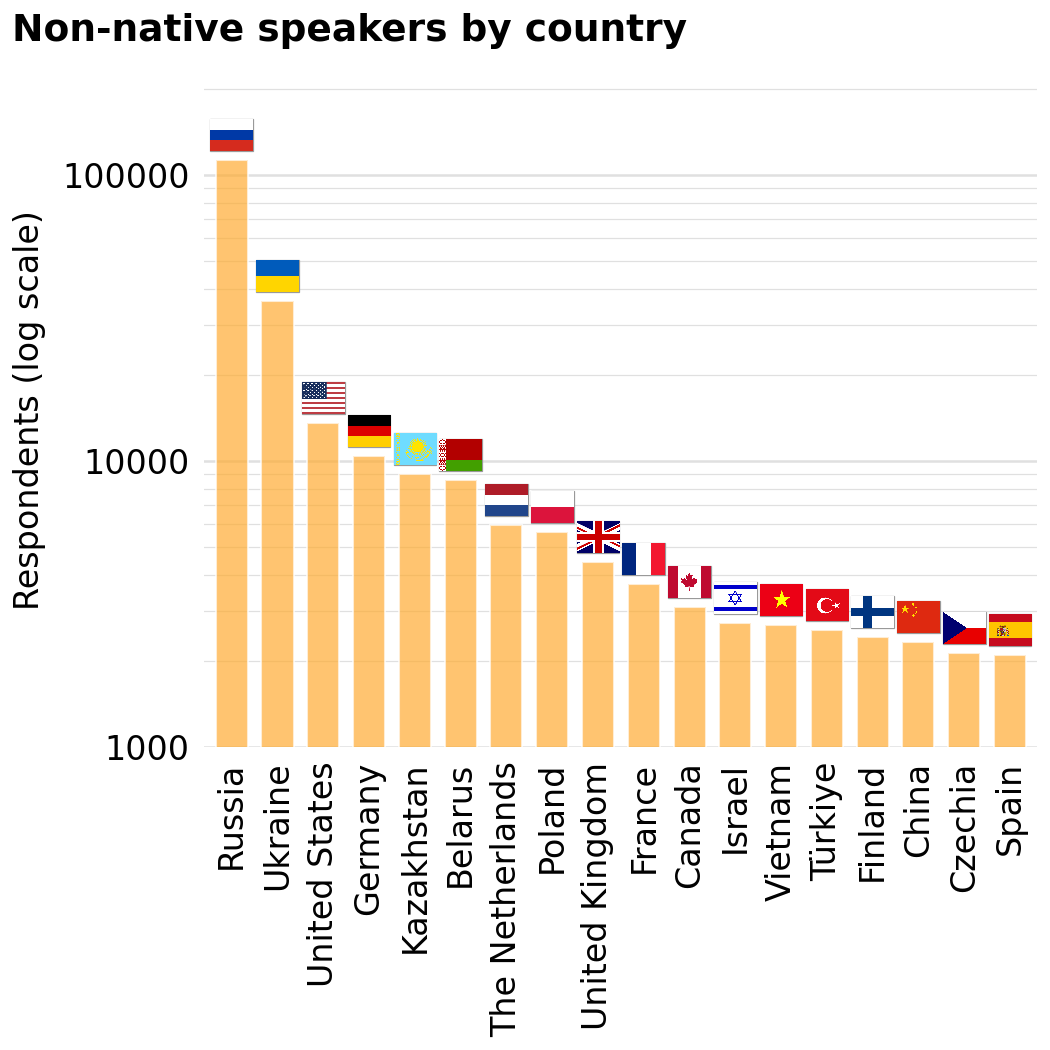
Only countries with at least 2,000 respondents are shown.
Most learners came from Russia (41%) and Ukraine (13%). Each of the remaining countries contributed less than 5% of participants.
Native speakers
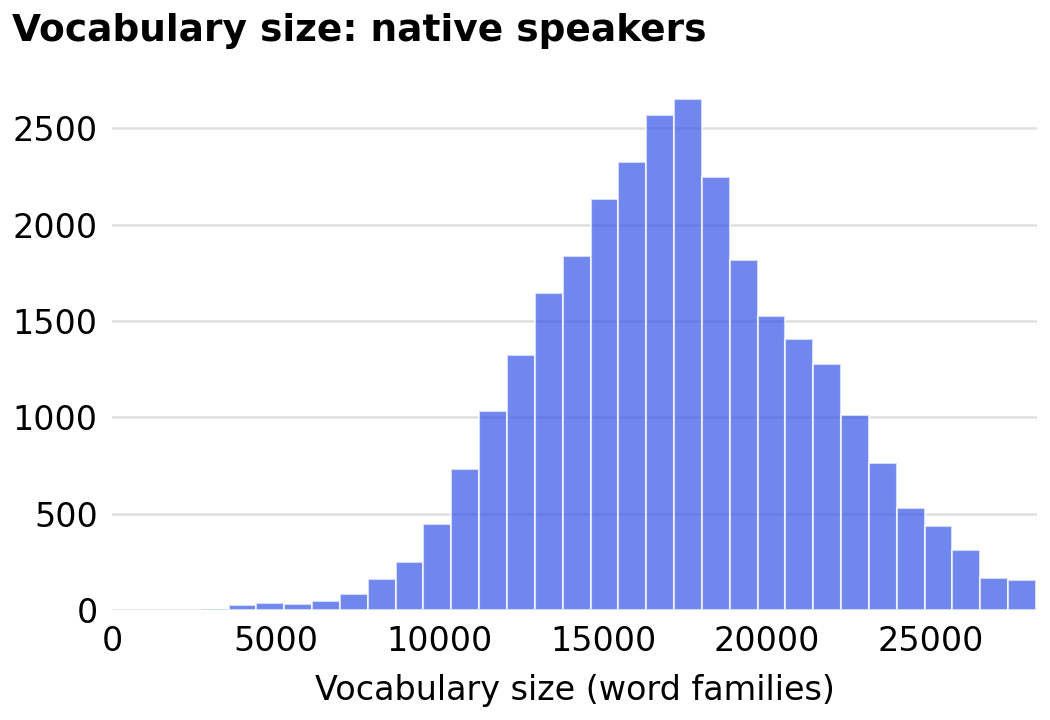
For native speakers (all ages):
- Median: 17,100 word families (half know fewer, half know more).
- 25th percentile: 14,400 word families (25% know fewer, 75% know more).
- 75th percentile: 19,900 word families.
- 90th percentile: 22,700 word families (top 10% of respondents).
Now, let's take a closer look at how vocabulary size changes with age.
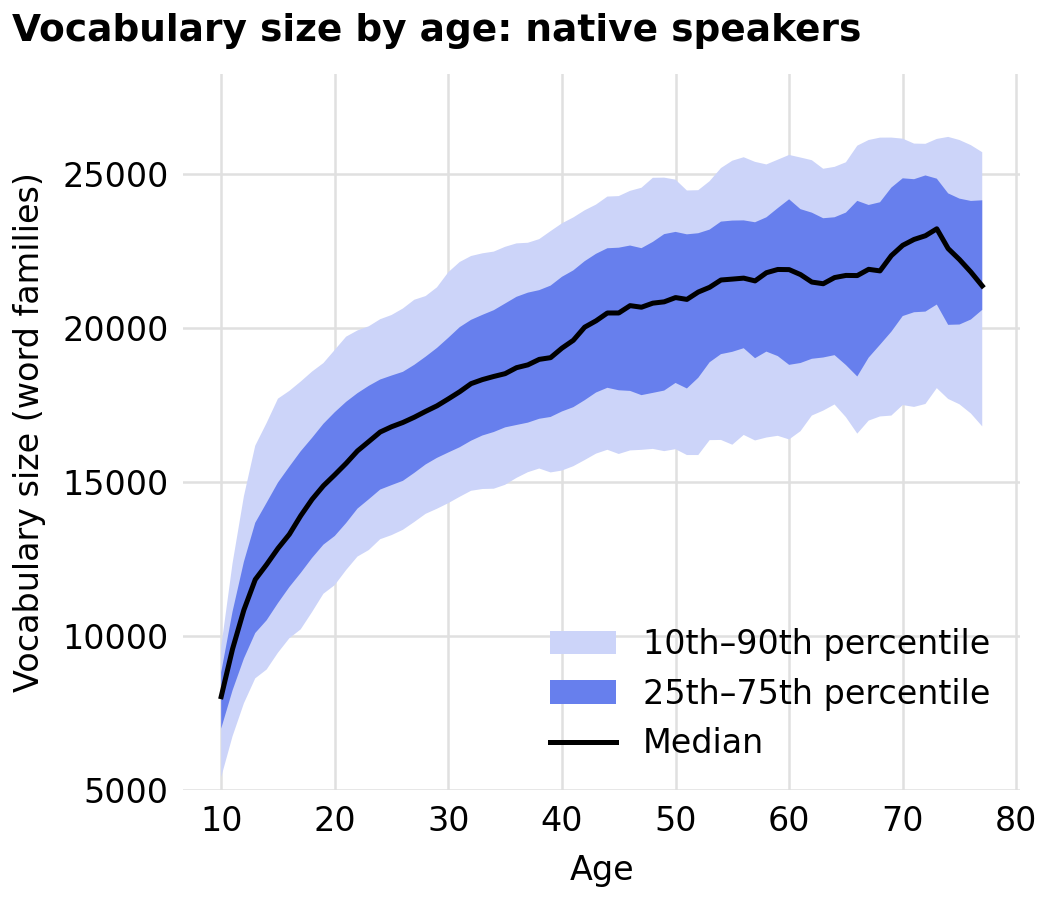
The vocabulary size of native speakers grows rapidly during formal education (up to age 18), then more slowly through adulthood. Here are the key numbers:
- At age 12 (elementary school graduation age), the median vocabulary size of native speakers is 10,800 word families.
- At age 18 (high school graduation age), the median vocabulary size grows to 14,400 word families.
- At age 22 (college graduation age), the median vocabulary size is 16,000 word families.
- Adults aged over 35 know, on average, 20,300 word families.
- Students up to 18 years old learn about 800 word families per year.
- Young adults (19–31 years old) acquire around 270 word families per year.
- Later in life (32–60 years old), vocabulary still grows, though more slowly, at about 140 word families per year.
Now to the impact of education.
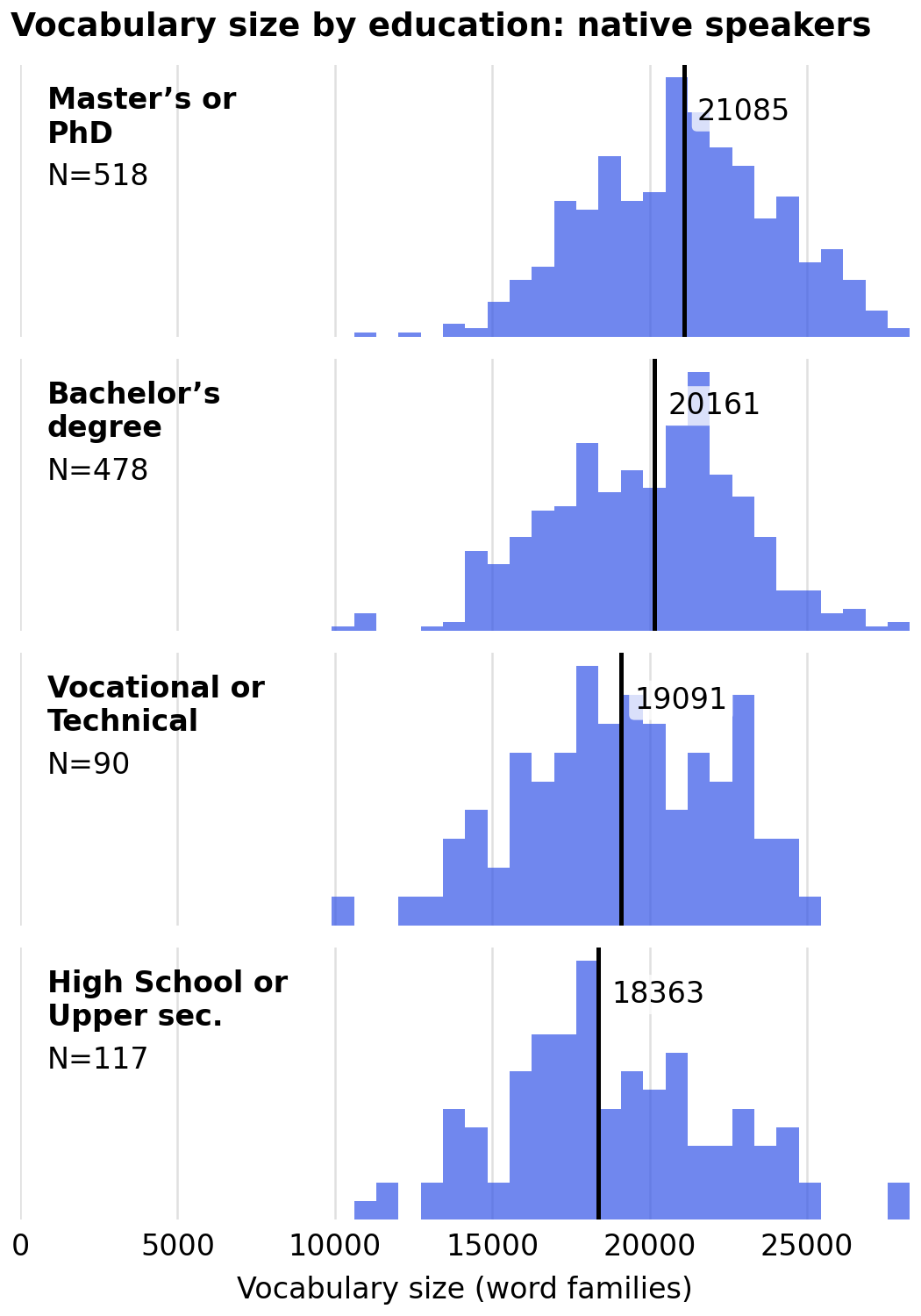
Only respondents aged 40 and older are shown. Vertical lines show medians.
The vocabulary size of native speakers increases with education level, but the effect is small, rising from 18,400 word families for high school graduates to 21,100 word families for those with a master’s degree or a PhD.
Non-native speakers
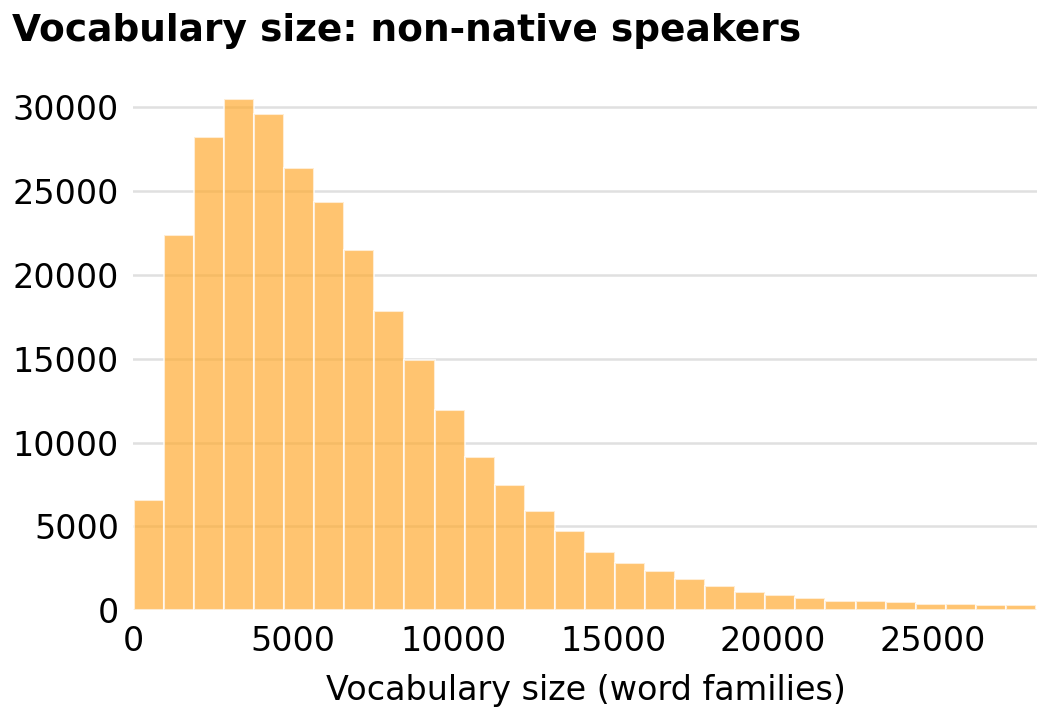
For non-native speakers (all ages):
- Median: 5,500 word families.
- 25th percentile: 3,200 word families.
- 75th percentile: 8,600 word families.
- 90th percentile: 12,300 word families (top 10% of respondents).
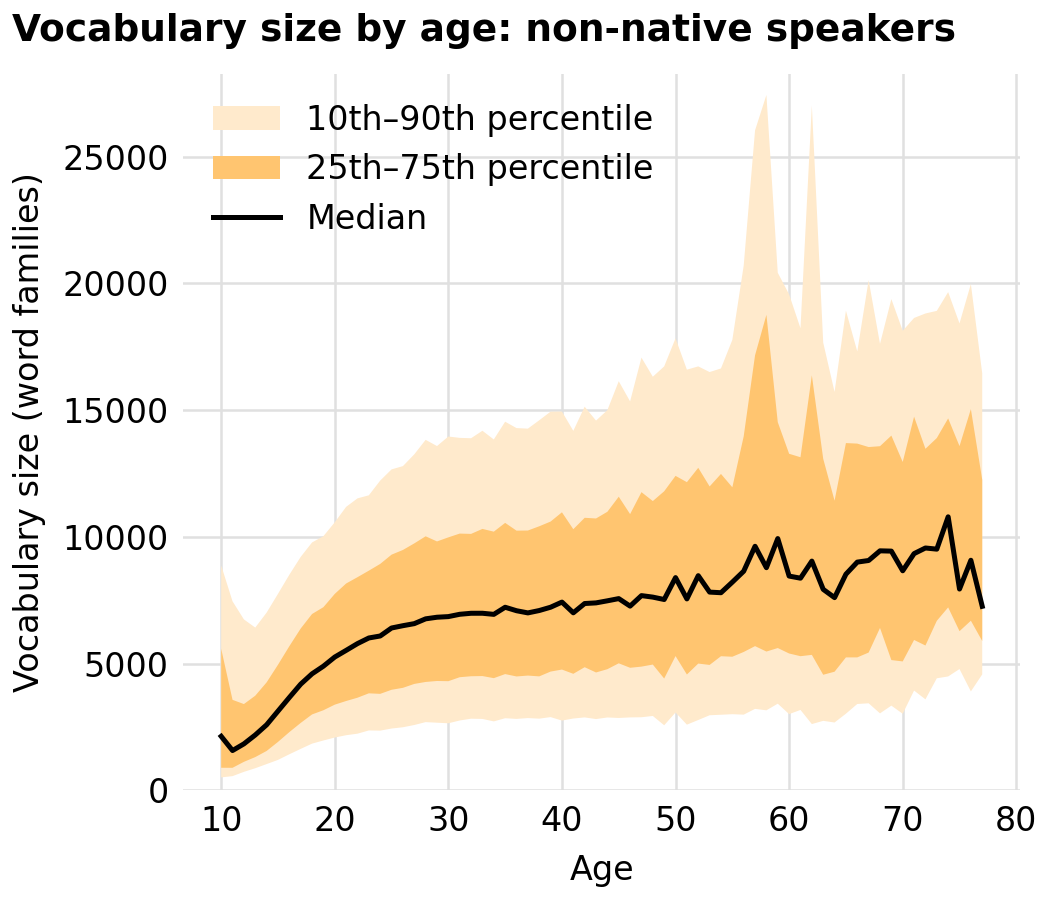
Here are vocabulary distributions for non-native speakers at different ages.
Here is how vocabulary grows with proficiency.
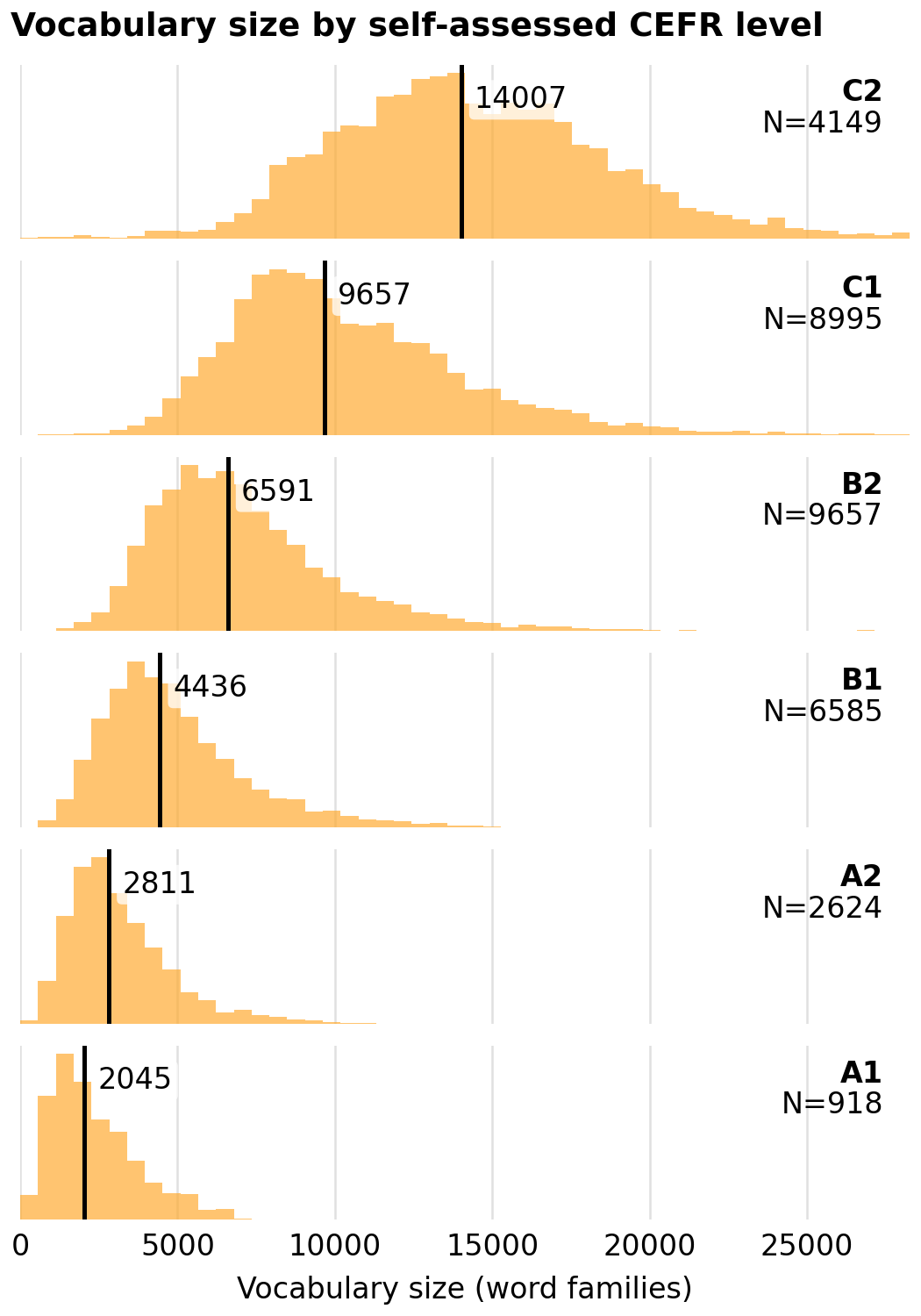
CEFR levels are self-assessed. Vertical lines show medians.
Frequently Asked Questions
How many words are in the English language?
Determining the exact number of words in any language is challenging, as estimates depend on what qualifies as an independent word versus a derivative. We follow the research of P. Nation and L. Bauer, who introduced the concept of word families. According to their work, English has at least 28,000 word families.
What counts as a word?
We measure vocabulary in word families, meaning that variations such as limit, limitation, limitations, limited, limiting, limitless, limitlessly, limits, and unlimited are all considered part of the same word family.
How can a vocabulary of thousands of words be measured with only 40 questions?
The test is based on Item Response Theory and Computerized Adaptive Testing—the most advanced methodologies in modern psychometrics (the science of psychological assessment). You can learn more about the inner workings of the test on the methodology page.
Can I compare these results to those of other vocabulary tests?
Unfortunately, no. Comparing results between vocabulary tests is impossible for several reasons:
- Each test uses different methodologies, measuring slightly different aspects of vocabulary.
- The definition of what counts as a word varies. Some tests include derived words, while others do not.
- Tests differ in how they define what it means to "know" a word.
- Not all vocabulary tests available online are scientifically rigorous. Only a small fraction are based on validated research methods.
Grigory Golovin
Last updated: October 10, 2026